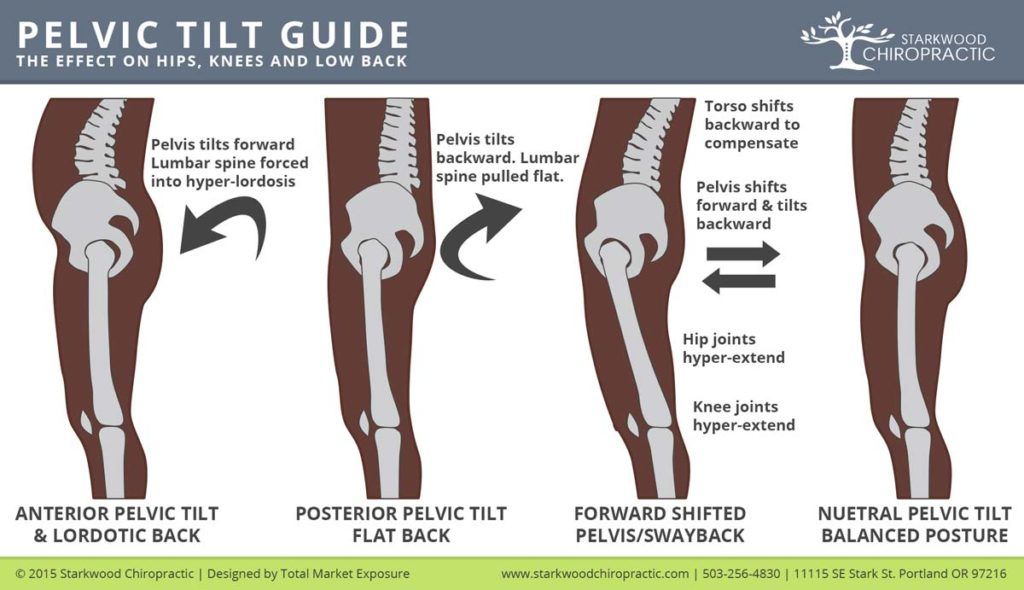
Posterior Pelvic Tilt (PPT) or “hip tilt” as it’s often informally referred to is a common problem that affects many Americans. A person can be affected by PPT if they don’t lead an active lifestyle or have poor posture whilst sitting at their desk. While the severe PPT can cause joint, knee and hip pain, it also makes your butt and gut protrude a lot more. These effects can cause pain and discomfort in other areas of the body. In addition to the pain, this can affect the way your clothes fit, and maybe even your self-confidence. Unfortunately, because this is a muscular/ skeletal problem, no amount of weight loss will help you get rid of that gut. Here’s some information to help you understand PPT a little better, as well as a few suggestions on how to combat it.
Posterior pelvic tilt is the medical term for hips that are excessively tilted forward or backward. There are a few different forms of pelvic tilt. Anterior pelvic tilt presents as an overly forward arched lower back. Individuals suffering from anterior pelvic tilt often appear to be sticking their belly and buttocks out. This is the result of the pelvis tilting forward forcing the lumbar spine into hyper-lordosis. Posterior pelvic tilt presents with the opposite causes and effects. Individuals suffering from posterior pelvic tilt can appear to be tucking their buttocks. This is the result of the pelvis tilting backward pulling the lumbar spine flat. The most common causes of unhealthy posterior tilt are sedentariness and lack of everyday activity.
If we sit a lot, our hip flexors “shorten” causing compensatory tension in the hamstrings. If you stand up and you have short hip flexors, the hamstrings will pull on the the hip, as well as your lower back. This is what causes the hip to tilt backward and the curvature in your lower back to flatten, thus making your butt and gut seem more prominent. Interestingly anterior pelvic tilt is caused by similar sedentary lifestyle choices, with opposite results.
To a certain extent, a slight pelvic tilt is common in humans. It depends on the way your body is built, your genes, etcetera. In fact, a slight pelvic tilt is more common in women than in men. However, one of the ways you can figure out if you have PPT is to perform the Thomas Test. To do so, get a friend to observe you, or film it with your cellphone/ webcam.
You don’t have PPT if: your thigh touches the table and the knee is bent with neither hip nor leg rotating or moving outward.
You might have PPT if: you need to extend the knee (i.e. straighten it) to touch your thigh to the surface of the table. This means your rectus femoris is short. Also, if your thigh cannot touch the table even after you’ve extended your knee, your psoas are short.
If your leg and hip need to move to the outside for the thigh to touch the surface of the table, your tensor fascia latae is short. If you notice any of these things, and your spine is even slightly curved, you will benefit from a few PPT corrective drill or exercises.
This website uses cookies.